 It’s kind of ironic the last book I wrote was about a young woman who struggled to find her way back to who she had once been, to doing what she had once loved. I say it’s ironic because that’s exactly what I’ve been going through for the past couple of months. I have not written a word, or even had the desire to do so. There has been an illness in my family and things were looking pretty dire. It’s amazing how your creative juices can be completely doused when your entire being is consumed with the uncertainty and fear of losing a loved one. When we write, the words come from our heart, from our soul. If those parts of you are already at capacity, there is little time or desire to tell a story. My son, who is an aspiring writer himself, was told by a co-worker that his book was not good. I wondered if that person knew how painful that can be to a writer who has just put part of themselves on a platter for the world to dissect and hopefully treat kindly. I have a feeling not. Anyway, for as dire as the prognosis of my loved one was, there is a new ray of hope. He is responding to an experimental treatment and the dark cloud that has been hanging over our family has scuttled quietly to the west. Still there, still within our vision, but moving far enough away to allow a little bit of light into our world. So for now….I can write.
Tag Archives: writing tips
It happened in a grocery store….
 I was thinking this weekend about the emotions of reading and writing. I love when I read a book that brings me to tears. It means that the author has pulled me in to his/her world and I’ve become invested in the characters. Isn’t it disappointing when you’re reading a book and it’s almost a chore to turn the page? You want so much to care about the characters but you just don’t. I know that it must be the intent of almost all authors to make you care about their characters, but where does it go wrong? Is it the failure of the author by keeping the characters too one-dimensional or is the failure of the reader to not find anything worth connecting to? I had a literary analysis teacher many years ago that told us that we connect, in movies and books, to what we are going through in our lives at that moment. While visiting my aging parents who are currently going through a health crisis, I saw an older man in the grocery store, his red-tipped cane announcing his lack of eyesight. His cart held only one item….a sleeping bag. By eavesdropping on the cashier and bagger, I found out that he is a homeless man who comes in to the store often to have a place to sit and relax. The man had gotten turned around in the store on this particular day and had to be directed to the bench. My heart was in pain, a cloud had come over the day. Was it because I’m overly sensitive because of what my parents are going through? Did I make a connection to the poor man’s plight because of my own situation? No matter the reason, my way of dealing with my pain is to put him in one of my books; give him a voice and provide him a happier ending than his reality.
Semi-comfortable yet?
 I love my husband. I just wanted to put that out there before I go any further. He’s a timeless jock with a heart of gold and shows his love through his actions. When I was a young, very poor, woman, in my first apartment and facing a Christmas without any means to celebrate, he surprised me with a Christmas tree and box of lights and ornaments. I knew that night that I would marry him. How could any woman pass up somebody that kind? He’s quite a guy. He is not, however, the smoothest talker in the world. He often says things that make my eyebrows jerk together. Tonight, as I tried my protect myself against the Midwestern winter winds by turning on our fireplace, he asked me one of those very unsmooth questions. “Are you semi-comfortable yet?” He was warm and wanted to turn the fireplace off. Was I semi-comfortable? Is that the best it’s going to get for me? Not “comfortable” just “semi-comfortable.” I could have been irritated at his question, but I just filed it away in the dialogue folder in my brain. You see, I am surrounded by an odd assortment of people who say odd things often. If you’re a fan of my books, you know that my male characters are often not sophisticated or smooth and sometimes trip over their own words. In Lost and Found in Laurel Ridge, when Trey calls Erin “boo” and she says “What have I told you about that?”—–that comes right out of my own life. In Wait for Me, when Kevin’s dad says “I-talian” with a long “i”—yep, that’s my dad talking. I don’t have to go searching for inspiration; these people I love are feeding me the words constantly. Semi-comfortable yet? I will find a place for that question in one of my future books. Now, excuse me while I put on a second layer of socks.
Inspiration in Appalachia…Part 2
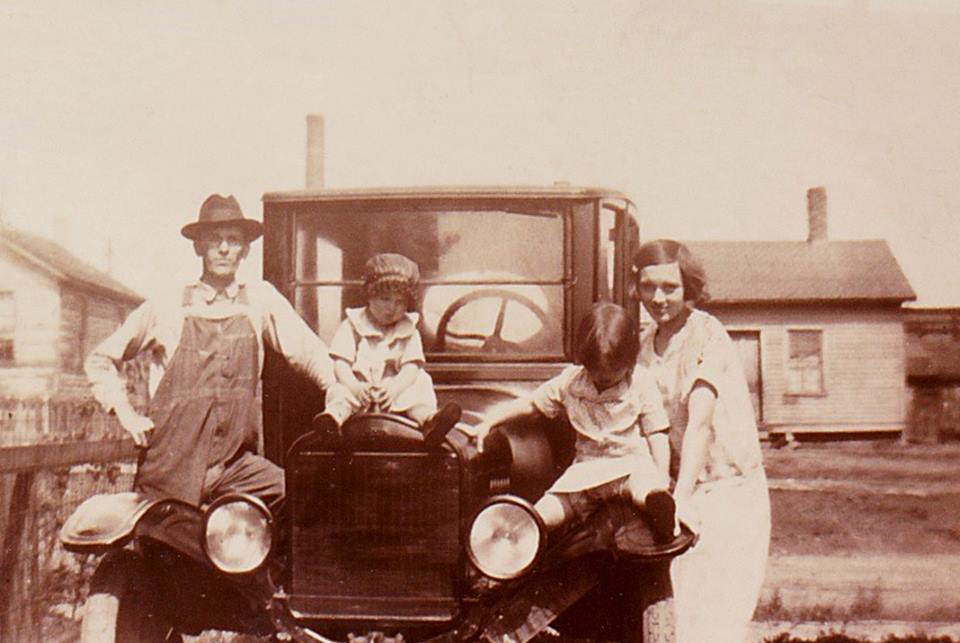 As I continue to research my new book, I am re-visiting my own family history. I often use my father’s family tree for inspiration in my writing, but this time I’m reaching into my mother’s lineage. This picture is of my great-grandparents, great-aunt, and my beloved late grandmother (she’s the toddler on the right). My great-grandmother, Hettie Elizabeth, looks happy in her role as a young wife and mother, but I know that times were tough. Little did she know that just a few years after this photo was taken, she would be in a TB hospital, separated from her husband and two little girls. She died at just 26 years of age, leaving Jarvis Jackson Cromer a widower at the age of 29. Yes, believe it or not, my great-grandfather was only in his mid-twenties in this picture! I love his body language, though—–kind of like “Don’t mess with me…ever.” What I’m learning about the people of Appalachia, though, is that they were (and are) inherently strong and proud people. They were fighters. They worked hard and loved harder and never forgot those who departed earlier than they should have. As my grandmother was facing her own mortality, she picked up a pen and began writing her history. She remembered every moment of the day she learned her mother had died in that TB hospital. Seventy years later, the pain of that day lived strong within her. When I miss her so much that it hurts, I pull out her memories. I hope that they continue to inspire me.
Taking a mental break…
 I love summertime. No, let me re-phrase. I live for summertime. I spent the first part of my childhood in the south before my parents packed up the station wagon and moved us to Cincinnati. Summer is short and precious in the Queen City. After publishing my latest book, The Ghosts of Wolf Island Creek, I made a decision. I am taking a mental break. I’m putting down my pen for the next two months. I’m going to jog through the woods, I’m going to take weekend jaunts, and I’m going to read. That’s right, I’m going to do the thing that I love most, the thing that made me want to become a writer. I’m going to put down my Kindle (sorry Amazon) visit my old friend, the library, and I’m going to read late into the night, early in the morning, and on my lunch break. Don’t get me wrong, my fingers are itching to start my next book. I already have the setting in my head, I already know the conflict, and the characters are already introducing themselves to me. What I need, though, is some time to just be. I’m going to people watch and explore new towns and–oh, did I mention that I’m going to read? Being a writer takes discipline. You have to be committed to research, word count per day goals, and editing (blah!) This summer, I’m going to find the discipline to NOT write. It’s time to replenish my life experiences and seek inspiration. Let the summer begin!
Parting is such sweet sorrow…
 It happens every time. As I am writing the final scenes of my book, I feel the melancholy rolling in. I know that I must say good-bye to my characters and it’s always a bittersweet parting. Anyone who writes knows that you don’t just think of your characters when you’re actually writing. You think of them while you drift off to sleep, while you’re supposed to be working at your day job, and while your husband is telling you that the grout on the bathroom floor is cracking. Your characters are talking to you all of the time; you created them, now you can’t shut them up. They are your friends, your enemies, your lovers. Then comes the moment when you must end the story and say good-bye. I’ve said before that I often pull one of my books off of a shelf just for a visit. There are characters I like more than others, but they are all my babies. As I put the finishing touches on my newest novel, I must take a deep breath and prepare myself for the inevitable good-byes.
When real life invades….
If you want to make God laugh, tell him about your plans–Woody Allen
A week ago, I had reached character nirvana. I couldn’t write quickly enough. The path of my newest book was laid out in front of me like a literary smorgasbord. Less than 24 hours after my last post, I took a tumble down a flight of steps. Not on purpose, of course; the steps just got in my way of safely making it from the second floor to the ground level of my home. I spent the next several days in pain and misery, covered in bruises and skin tears and, in general, hating life. I didn’t touch my computer once. My characters languished, stranded in the creek in which I had left them, waiting for direction. As I returned to my book for the first time in days, I was irritated and frustrated that I needed to find that sweet spot in my writing again. I know I’ll get back there but I hate losing control over my life and my writing. We like to define ourselves as writers, but sometimes we are reminded that we are above all humans; clumsy, easily-bruised humans.
Achieving character nirvana….
 One of the best moments when writing a novel is when you achieve character nirvana. It’s that moment when you really tap into your main character’s psyche and understand his or her motivation and eventual path. In the beginning of a new book, you’re just getting to know your characters. Some days are harder than others–you can’t figure out what they would say next or how they would react in certain situations. Some of the words seemed forced and the flow of the novel seems compromised. Then, something magical happens. Somewhere, in the middle of a sentence, the characters become real. They take on shape and substance. You’re no longer searching for the right words; you’re just writing down what they’re saying. They have become real people finally. It’s a beautiful moment in the life of a writer.
I’m just a word-nerd at heart….
 I love words. I love the shape of them, the feel of them, the sight of them. I love hearing them in different accents and different languages. In my real life, I’m a speech language pathologist. I work with adults who have had their words taken away from them by strokes and tumors and brain injuries. My mother asked me once if my job made me sad because I worked with people who were suffering and I told her that it’s hard to describe the joy of hearing an adult speak their first words again. When I write, I love to play with words and see how they change the meaning of what I’m trying to convey. Two nights ago, I wrote an entire scene in my new book using phrases like “His lips curved into a smile” and “His eyes lit with amusement.” As I was documenting therapy sessions at work, it hit me (yes, I think about writing while I’m working) that I was writing that scene all wrong. I came home and changed the phrases to “His mouth thinned in anger” and “His eyes darkened.” Maybe I’m a word-nerd but it thrills me that you have the ability to change the whole tone, the whole direction of a scene by exchanging one word for another. Words are simple yet powerful, there are an infinite supply of them, and they are free for the taking. Is there anything better in this whole world?
A room of my own…
 A woman must have money and a room of her own is she is to write fiction–Virginia Woolf
When my older son moved out and my younger son moved into what he had always perceived as the “better” room, we turned his room into a guest room, complete with twin beds and a small bookcase with young adult books. At some point, though, we had to face the hard fact that there would be no more sleepovers. My younger son was approaching high school graduation and, believe it or not, nearly-adult men don’t often indulge in sleepovers. So we put the beds on Craig’s list and I fulfilled my dream of creating my own space in which to write. I never knew what I was missing. I have an over-sized chair and ottoman, a desk, music, and (most importantly) books. Rows and rows of books. At times, my husband will stick his head into the room and ask how the writing is going and is surprised to see me reading. “Research,” I mumble and return to a particularly juicy love scene. The point is, though, you have to have your own space, free of the distractions of being a parent, a spouse, a pet-owner, and an obsessive-compulsive house cleaner. In my room, my characters are free to walk around and talk to each other while my fingers on the keyboard try to frantically keep up with them. Find a space and make it yours; your characters will be waiting for you.
 Sandy Huth